Annual Lecture on Reproduction with Prof. Dr. Andrea Whittaker
🗓️ Thursday, 26. November
🕐 5.15 – 6.45 pm
📍KOL-E-18
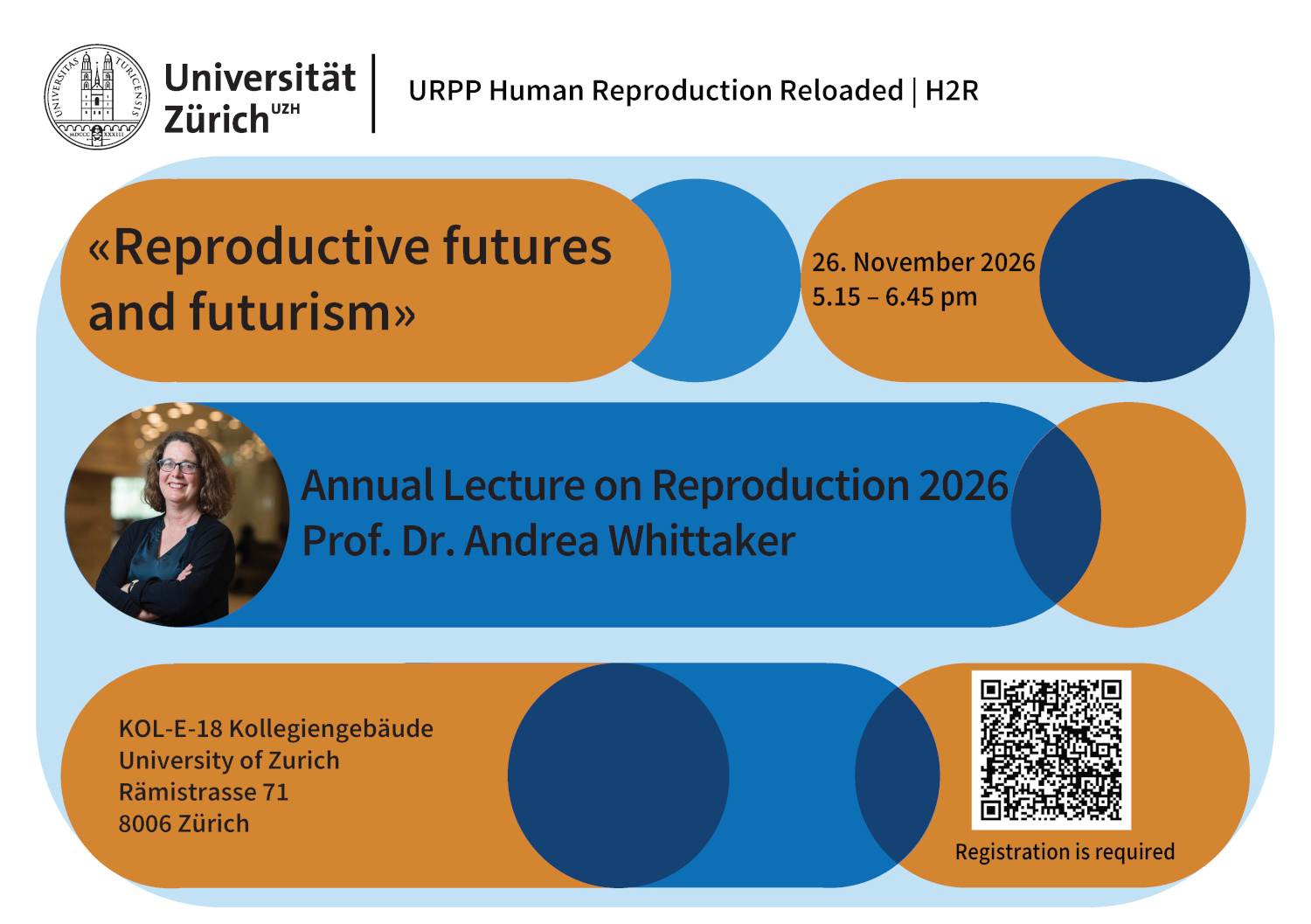
The URPP "Human Reproduction Reloaded" is delighted to announce that Prof. Andrea Whittaker (Monash University, Melbourne, Australia) will deliver the 2026 Annual Lecture on Reproduction, titled "Reproductive futures and futurism".
The lecture will take place on Thursday, 26 November 2026, 5.15 – 6.45 pm.
Registration is required to participate in the event.
About Prof. Andrea Whittaker

Professor Andrea Whittaker is Professor of Anthropology at the School of Social Sciences, Monash University, Melbourne, Australia. She is a medical anthropologist working primarily in the fields of reproductive health and biotechnologies with a special interest on Thailand and SE Asia. She is author of over 153 peer reviewed articles and is a Fellow of the Academy of Social Sciences in Australia and a member of the College of Experts for the Australian Research Council. She received her PhD from the University of Qld in 1995. Her major publications include Intimate Knowledge: Women and their Health in Northeast Thailand (2000), Women’s Health in Mainland South-east Asia ed. (2002), Abortion, Sin and the State in Thailand (2004) and Abortion in Asia: Local dilemmas, global politics ed. (2010); Thai in vitro: Assisted reproduction in Thailand (2015) and International Surrogacy as Disruptive Industry in South east Asia (2019) and she is currently working on a book provisionally entitled Uterus.
Reproductive futures and futurism
A range of new reproductive possibilities in genetic screening and editing, uterine transplants, bio-engineered wombs, ovarian tissue transplants, and gametogenesis lie in our foreseeable future. In this talk, I will explore some reproductive technologies and the imaginaries of the future they entail. I am defining futures not just in terms of temporality (relationships between the past, present and future) but in terms of narratives of futurism to evoke the predictions of positive and vital human progress associated with the power of technologies. With regard to reproduction, I suggest these visions of the future position the present, engaging us in differing orientations and possibilities such as: the extension of fertility through ovarian tissue implants; the externalisation of fertility through the end of the need for third party reproductive assistors due to gametogenesis and uterus transplants; the engineering of artificial wombs; and editing through gene selection technologies. These various technologies are inherently pronatalist in orientation, aimed towards the production of a future generation, unlike the contraceptive technologies of a generation past (when a vision of the future and the objects involved were oriented towards the management of the spectre of over-fertility). I consider how the present form of reproductive futurism is reinventing our conceptions of gender, health and embodiment and promising a future in which endlessly flexible interventions and malleable applications purportedly allow for a myriad of new reproductive choices beyond the failings and uncertainties of the body, oblivious to the old stratified inequalities they entail. To what extent do these futures foreclose other interventions? And how do narratives of hope and hype associated with these technologies overlook the significant social and ethical issues posed?