New publication by Larissa Fritsch & Dr. Sandra Gilgen
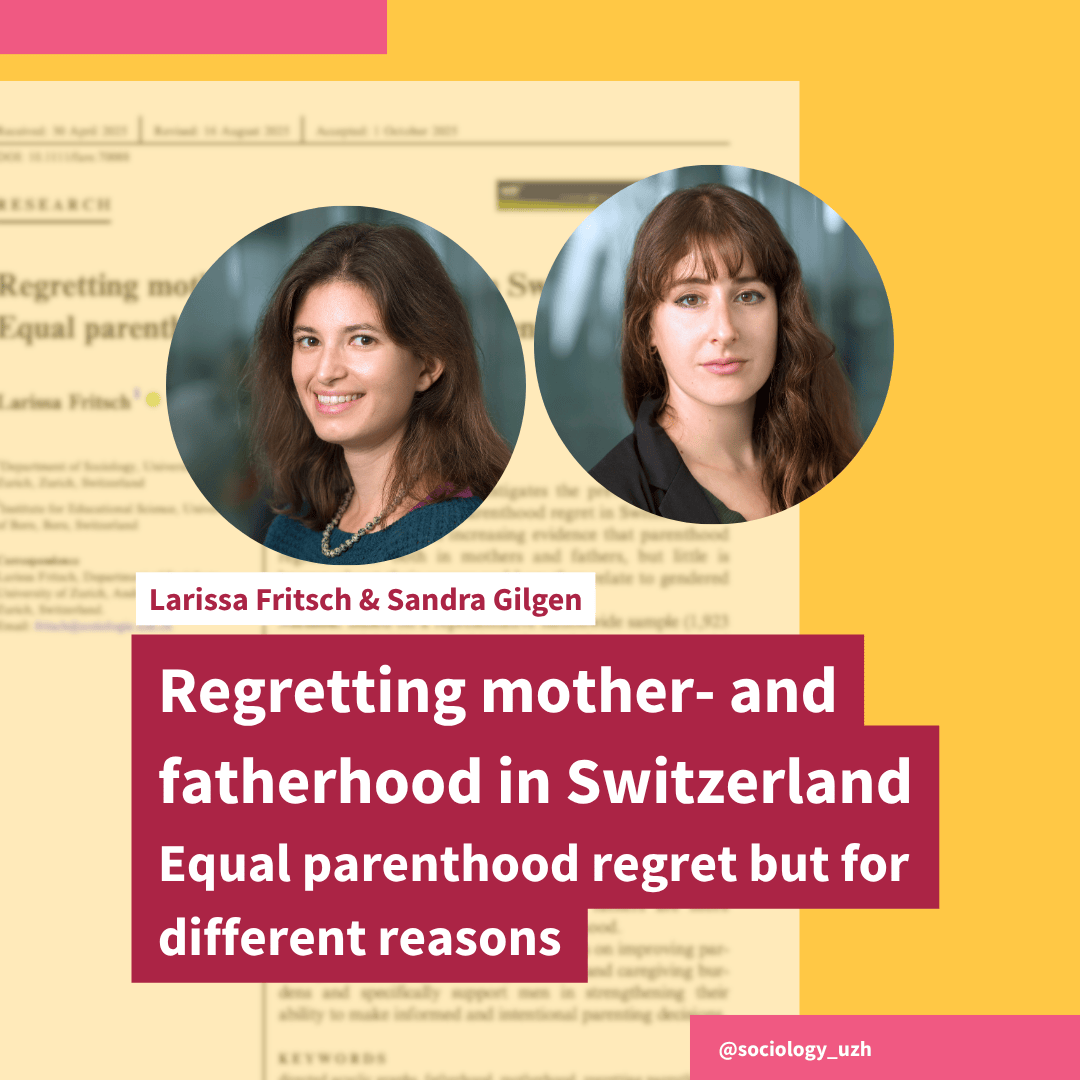
Parenthood regrets are related to lower mental health of parents after childbirth and can cast a shadow on family life (East et al., 2012; Piotrowski et al., 2024). With the seminal research on women who answered no to the question “If you could go back in time, with the knowledge and experience you have today, would you be a mother?,” parenthood regret was put on the sociologist's research agenda in 2015 (Donath, 2016). Several follow-up studies that investigated parenthood regret in Spain (Meil et al., 2023), Poland (Piotrowski, 2021), and Germany (YouGov, 2016) found a share of 5% to 20% of parents reporting parenthood regret for both mothers and fathers (Meil et al., 2023; Piotrowski, 2021). However, in Germany, parenthood regret was primarily framed as an issue arising from the difficult circumstances that primarily affect mothers trying to balance family obligations and work (Heffernan & Stone, 2021). To our knowledge, no study on parenthood regret has been conducted in Switzerland to date. However, Switzerland is an interesting case because of its rather conservative “breadwinner-model” culture—manifesting itself in a gendered work–household work gap among parents (most mothers work part-time, most fathers work full-time; Swiss Federal Statistical Office, n.d.) and low state support for professional child care—but with increasing female employment and liberal labor market characteristics (Beyeler & Annesley, 2011). This setting is likely to put high pressure on mothers, with increasing societal expectations on fathers to spend (quality) time parenting. In this article, we follow two goals: First: (Q1) How common is parenthood regret in Switzerland? Second, we aim to disentangle the underlying mechanisms: (Q2) What factors are associated with feelings of parenthood regret among mothers and fathers? Continue reading